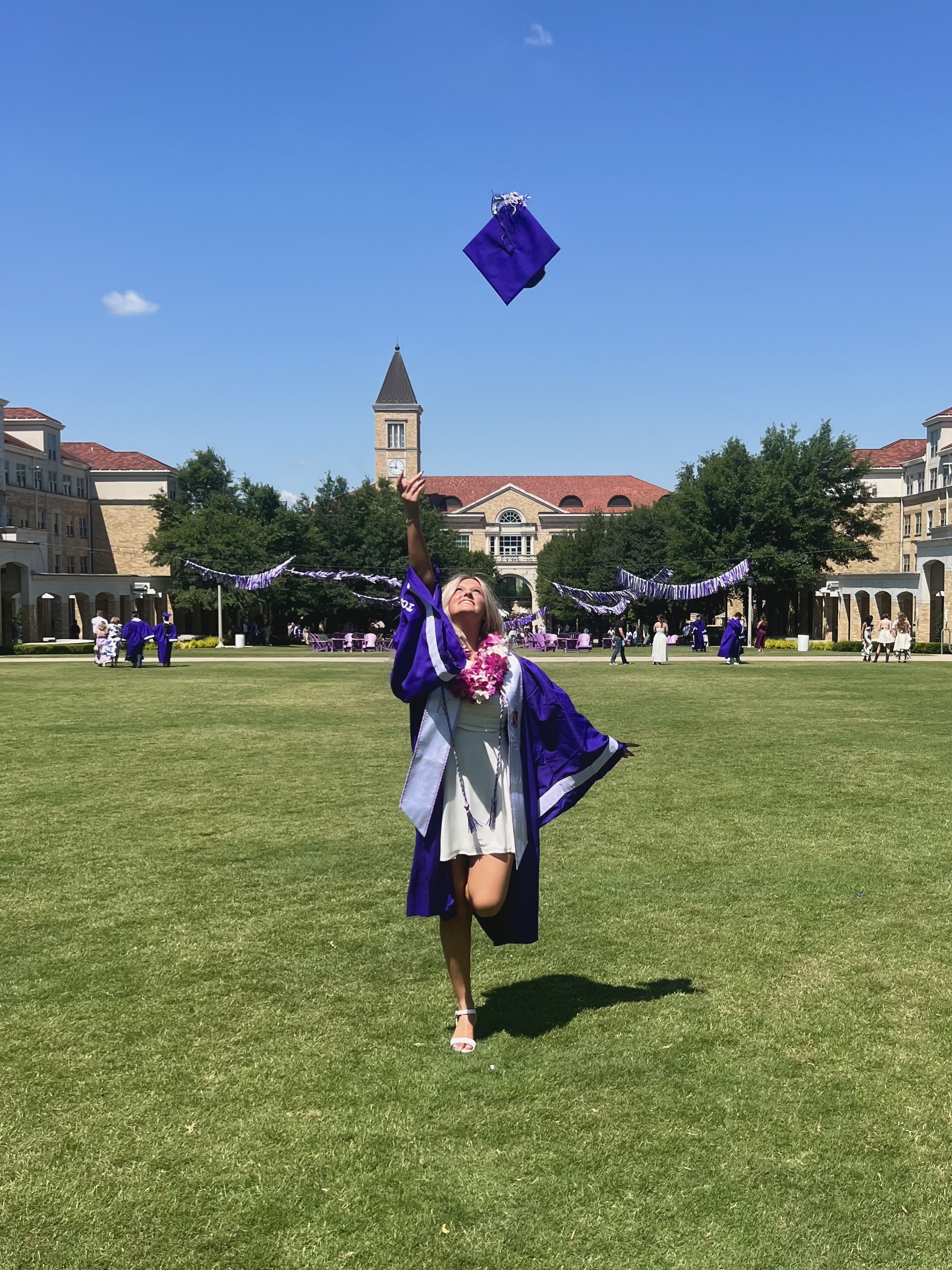
A Coin Flip, a Cross-Country Move and a Career at Dell: Michala Rogers’ TCU Story
The coin landed on the other school.
Michala Rogers ’25 chose TCU anyway.
When Rogers was deciding between her final two colleges, she used a trick she turns to for big decisions: flip a coin. Not because she planned to let chance choose for her, but because her reaction to the result usually tells her what she actually wants.
This time, the coin chose the other university. Rogers immediately wished it had landed on TCU.
“That was all the clarity I needed,” she says.
Within minutes, she logged into her admission portal and committed to a university more than 1,500 miles from her hometown of Darien, Connecticut. Four years later, Rogers graduated with a degree in computer information technology and a minor in art history. Today, she works at Dell Technologies as the Global Transition Manager for Alienware and XPS.
Looking back, that coin flip became part of a much bigger lesson: sometimes growth begins by choosing the place you did not expect.
Choosing Something Completely Different
Texas was not originally part of Rogers’ college plan.
Rogers attended a small, all-girls Catholic school in Greenwich, Connecticut. She valued that experience, but for college, she wanted something bigger — a place where she could meet people from different backgrounds, challenge herself and experience everything college had to offer.
She was looking for strong academics and professional opportunities, along with Division I sports, traditions and an involved campus culture.
Rogers conducted her college search during COVID-19, making campus visits more difficult. After applying to about 10 universities across the country, she was admitted to TCU through Early Action and attended an admitted-student event the following March.
“That visit is what changed everything for me,” Rogers says.
After exploring campus and Fort Worth, she could picture herself spending the next four years there. Instead of seeing the distance between Connecticut and Texas as a drawback, she began seeing it as part of the opportunity.
“It was so different from where I grew up, and that was exactly what I was looking for,” she says.
From Conneticut to Fort Worth
Moving from the Northeast to Texas came with a cultural adjustment.
Rogers arrived with some of the expectations a Northerner might have — cowboys, rodeos and boots included. She soon discovered those traditions were genuinely part of life in Fort Worth. Rodeos at the Stockyards became favorite outings, and she bought the first of many pairs of cowboy boots at M.L. Leddy’s.
She also quickly learned that Fort Worth offered more than the Texas traditions she expected. Rogers describes it as a place with the opportunities and entertainment of a major city while still feeling like a college town — the benefits of a big city without feeling overwhelmed.
Even some of her favorite places became markers of how much Fort Worth had become part of her story. Wicked Butcher was the first restaurant she visited during her admitted-student trip. Four years later, she returned there for her graduation dinner.

She was also struck by how closely Fort Worth embraced the university.
“No matter where I went, who I talked to or even whether they attended TCU or not, it felt like everyone in Fort Worth bleeds purple.”
Her own TCU community began forming before classes even started. Through Orientation, Frog Camp and sorority recruitment, Rogers arrived on her first day already recognizing familiar faces.
She joined Sigma Kappa, where she found some of her closest friends and became involved with the sorority’s philanthropy supporting the Alzheimer’s Association, a cause that was personal after losing her grandfather to Alzheimer’s disease.
“TCU quickly went from feeling like a brand-new place to feeling like home,” she says.

For Rogers, though, finding a home at TCU did not mean leaving her first one behind. She came to see attending college far away as “the best of both worlds”: summers and holidays with family and friends on the East Coast, and Texas waiting for her during the school year.
Finding Confidence in Computer Information Technology
Rogers found another close-knit community through TCU’s computer information technology program.
Being part of a smaller department allowed her professors to know her beyond her grades — something that became especially important during her freshman year.
After struggling with challenging early courses, Rogers began questioning whether she had chosen the right major. She went to a professor’s office hours and told him how she was feeling.
“He told me how capable and intelligent he believed I was, and that he had no doubt I would not only do well in the major but excel in it,” Rogers says.
Because the professor already knew her as a student, the encouragement carried weight. She stayed with the program.
“Throughout my four years at TCU, I had professors who genuinely cared about my success and were willing to invest their time and energy in helping me grow,” she says.
That faculty support came alongside hands-on technical experience. TCU’s computer information technology program includes a year-long senior design experience in which students work together to develop a solution for a real-world client.
For Rogers, that project was FrogCrew.
Working with a student team, she helped develop a web-based scheduling platform for TCU Sports Broadcasting. The system was designed to make coordinating broadcasting crews easier by bringing availability, assignments, schedules, shift swaps and notifications into one place.
The project also led to one of Rogers’ final memories as a student.
During the last week of senior year, she had to miss Senior Sunset to present her capstone to computer science faculty. Her boyfriend, whom she met at TCU, surprised her with a sunset of their own.
They grabbed snacks, went to the football stadium and spent hours talking about their favorite memories, friendships and what was coming next.
“It was such a simple evening, but it ended up being the perfect way to say goodbye to a place that had meant so much to us,” Rogers says.
From TCU to Dell: Translating Between Technology and Business
Rogers knew early on that she wanted a career at the intersection of business and technology.
Although she studied computer information technology in TCU’s College of Science & Engineering, she intentionally took business courses and pursued professional development opportunities outside her degree plan.
Along the way, she developed a skill that has become central to her career: the ability to “translate” between technical and non-technical audiences.
Rogers joined Dell Technologies in 2025. Today, she regularly works with engineers, business leaders, marketing teams and executives who may approach the same product from very different perspectives.
Her technical background helps her understand complex technology, while the communication, leadership and relationship-building skills she strengthened at TCU help her make that information meaningful to the people around her.
“Being able to understand highly technical concepts and communicate them in a way that is approachable and actionable has been one of the biggest contributors to my success,” she says.
Eight months after starting at Dell, Rogers earned her first major promotion. She moved from owning an internal tool and project-managing work involving approximately 200 users and a development team to becoming Global Transition Manager for Dell’s XPS premium laptop and Alienware gaming portfolios.
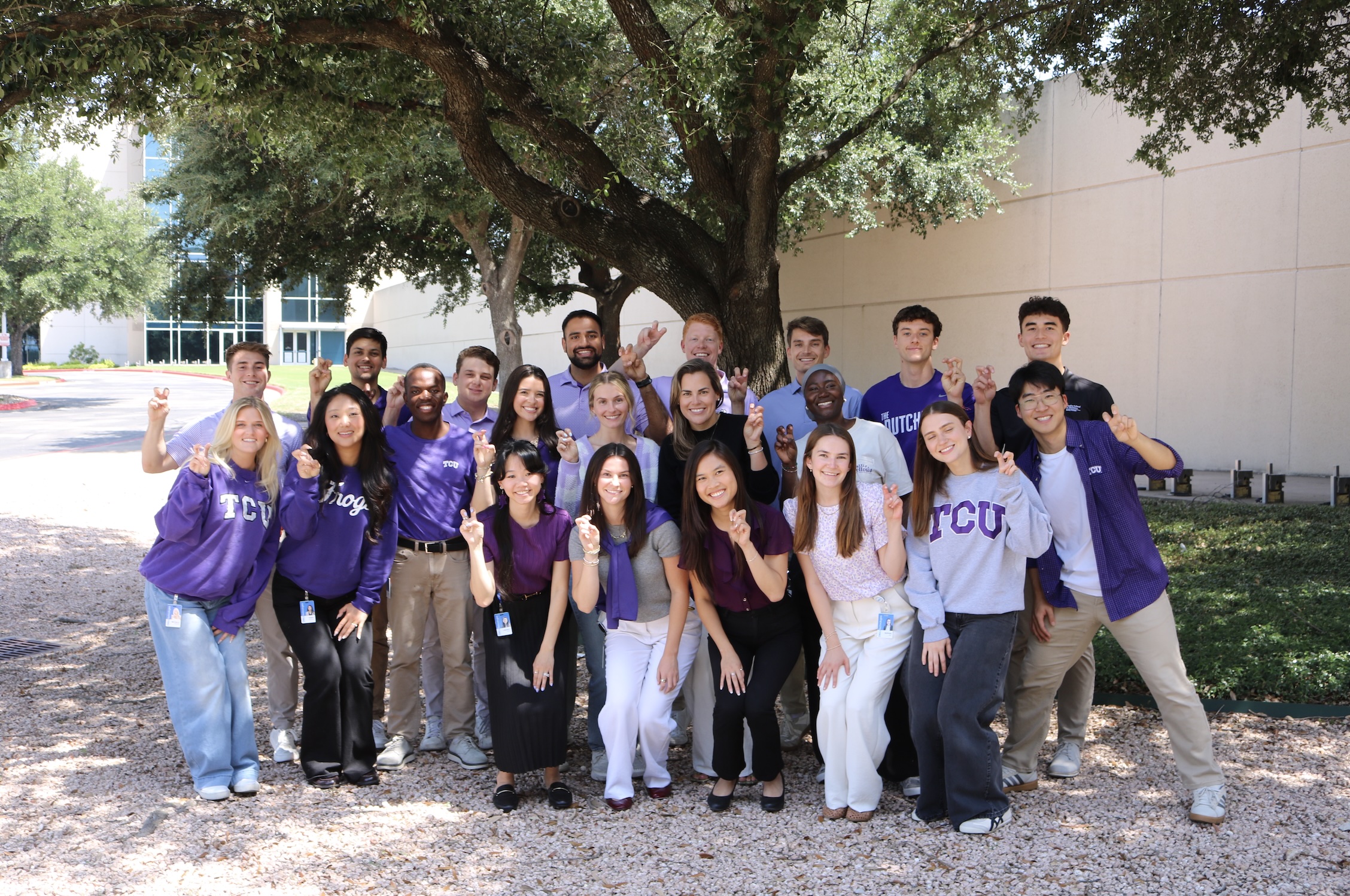
Starting her career also meant another move. Rogers left Fort Worth for Austin, once again entering a city where she had to build a new community.
This time, she knew she could do it.
“I came to TCU from Connecticut knowing no one and spent four years building an incredible community of friends, mentors and experiences,” Rogers says.
Moving across the country for college had already taught her how to adapt, form relationships and create a life somewhere unfamiliar.
“TCU is one of the ones that taught me the most that growth often comes from putting yourself in environments that challenge you,” she says.
For Students Considering TCU From Far Away
For students in Connecticut or elsewhere in the Northeast, Texas can sound much farther away before college than it feels once you are there.
Rogers stayed close to family and friends through visits, school breaks and calls. During freshman year, she even used her walk from her residence hall to classes as an opportunity to call someone from home.
She never felt that building a life at TCU required giving up the one she already had in Connecticut.
She also discovered she was far from the only student navigating that transition.
“TCU attracts students from all over the country,” Rogers says. “Even though I was far from home, I never felt out of place.”
There were other students learning how to build a community away from home, too. And before long, Rogers found herself missing her TCU friends when she returned to Connecticut just as much as she missed home while she was in Texas.
Her advice is simple: do not eliminate a university you are excited about because of the miles between it and home.
“The world is so much bigger than your hometown,” Rogers says. “If TCU feels like the right fit for you, don’t be afraid to take that leap.”
For Rogers, that leap began with a visit to a Texas university she had never expected to attend — followed by a coin toss that technically told her to go somewhere else.
She chose TCU instead.
Four years later, she left with a degree, a career waiting at Dell, friendships she still carries with her and two places she could call home.
“I am so glad that I flipped that coin and came here.”
Ready to Take Your Own Leap?
Explore TCU’s Computer Information Technology program and plan a campus visit to see what life as a Horned Frog could look like for you.