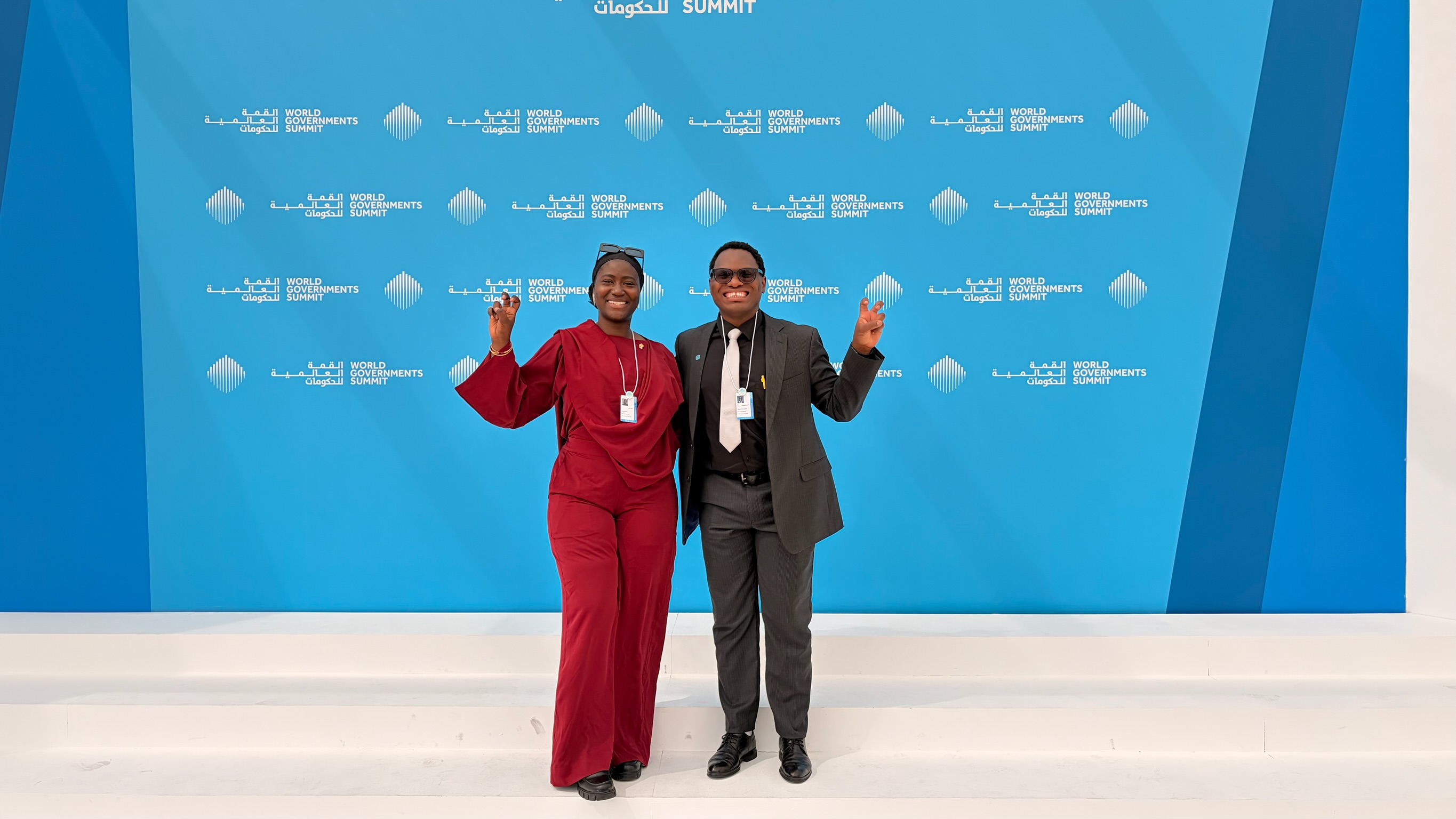
TCU Students Win Gold at World Governments Summit for Bakame AI
For Happy Niyorurema '28 and Diarra Niang '27, Bakame AI started with a problem they understood personally: too many students are expected to learn online without reliable access to the internet.
Niyorurema, a junior double-majoring in economics and finance, was raised in Rwanda. Niang, a senior double-majoring in economics and business information systems, was raised in Senegal. As international students at TCU, they brought their experiences together to build a student-led solution for communities that are often left out of the digital conversation.
“With AI, we didn’t want to wait five decades for everyone to have a smartphone and 24/7 internet access,” Niyorurema says.
A Tool Built on Lived Experience
That idea became Bakame AI – whose name means “listen” in Kinyarwanda – an AI-powered education system designed to work without a smartphone or internet connection. Instead of relying on an app, Bakame AI uses interactive voice systems, existing mobile networks and toll-free numbers. Students can call in and connect with educational content using technology many already have access to.
Bakame is a Kinyarwanda name, and for Niang, that was part of what made it resonate. "In Rwandan folktales, Bakame is the hare, the small clever one who wins through wit rather than size," she says. "Bringing Wolof and other Senegalese languages into Bakame felt like adding my grandmother's voice to a conversation that began in Kigali. Our cultures have always known how to teach. We are giving that tradition a new phone line."
Before working together on Bakame AI, Niyorurema and Niang knew each other through TCU's African Student Organization, where they often talked about technology, politics and ways to expand opportunity back home. Niang had already developed a GPT agent to help students in Senegal find global opportunities – work that made her a natural partner for the project.
“From those occasional interactions and the need for a team, I eventually invited her to join Bakame – to expand my dream of access, but also to help with partnerships, especially in the West African market and French-speaking territories,” Niyorurema explains.
For Niang, joining wasn’t a hard decision.
“I grew up watching the problem Bakame solves,” she says. “I was born in Senegal, and I learned early that opportunity often depends on where you happen to be standing. So, when Happy pitched Bakame to me, there was no hesitation. I had spent my whole life watching – and being – the exact person it was built for.”
Their mission comes from both lived experience and frustration with how slowly technology can reach the people who need it most.
“It is simply frustrating how long technology takes to diffuse to those who need it most,” Niyorurema says.
Through a phone call, students can interact with an AI-powered learning assistant that can support lessons, answer questions and help users continue learning without requiring traditional internet access. For the team, the goal is not just to build something impressive. It is to build something useful.
How TCU Helped Turn an Idea into a Movement
At TCU, Niyorurema and Niang found support that helped move Bakame AI from an idea into a project with real-world potential.
“From the beginning, TCU was the first to believe in us,” Niyorurema says.
Through the CREATE Accelerator program, the team received mentorship and funding to develop its minimum viable product, connecting them with resources and advisers who helped the project mature. TCU International Services also played a critical role, guiding the students as they navigated the process of building a venture while staying visa compliant.
“As international students, the International Services team – especially Joshua Kai – has been instrumental in advising us on how best to do this while staying visa compliant,” Niyorurema says. “We’ve really appreciated that, and it is a great resource.”
Continued backing from the Office of Innovation and Strategy helped sustain the project’s momentum as CREATE alumni. That support, layered across multiple offices and mentors, helped two international students step onto a global stage with confidence.
“TCU has taught me to be a go-getter,” Niyorurema explains. “There are not many opportunities where one will be invited to the table d’honneur, so TCU taught me to take my chair instead.”
Taking the Stage in Dubai
The project recently earned first place in the Global Best M-Gov Award at the World Governments Summit in Dubai, one of the most prominent gatherings of government leaders, innovators and policy experts in the world. The award recognized Bakame AI for using artificial intelligence to expand educational access for communities with limited smartphone and internet access.
At the summit, Niyorurema and Niang entered rooms filled with prime ministers, presidents, Nobel economists and international policy experts. For a student-led project, the experience was both exciting and validating.
“It was overwhelmingly amazing – nothing like I have ever seen,” Niyorurema reminisces. “Imagine a room the size of a TCU classroom, sometimes even smaller, with 10 prime ministers, five presidents, Nobel economists and the president of the International Monetary Fund.”
The team also connected with leaders and representatives from Rwanda, Senegal, Zambia, Ghana, Kenya, Bermuda and other countries, along with technology founders and international policy experts.
For Niang, standing in that room carried its own weight. “Surreal at first, and then clarifying,” she says. “You realize how rarely West Africa is present in those rooms as a builder rather than a case study. We are usually the statistic on the slide. This time, we were presenting the solution. I thought about students back home in Senegal the entire time, because once you have seen it done, it stops being impossible. The reception back home was so humbling too – that, more than the trophy itself, is what has kept me going since.”
Winning the gold award was a moment the team will not forget.
“We had always been confident in what we were building and ambitious enough to stretch our boundaries of access to the Global South,” Niyorurema explains. “However, nothing compares to winning the Gold award."
What Comes Next
Since Dubai, the team has moved quickly to turn recognition into real-world deployment.
In Rwanda, Bakame signed a SIP transit agreement with Airtel Rwanda, giving the platform a direct national telephony path — any Rwandan can now reach the Bakame tutor from any phone, smartphone or not, connected or not. The team has also moved fully off Twilio, a shift that makes a national-scale rollout economically viable, with a public pilot targeted for this summer through the Airtel path, alongside the previously announced deployment with IDebate Rwanda and Isomo.
In Senegal, the team is in advanced discussions with the Senegalese government on a national deployment. Final terms are still being worked out, and the team expects to share more once an agreement is signed.
The team is also training a Kinyarwanda voice model on NVIDIA DGX hardware, with early runs showing meaningful improvements over base models using less conventional, more compute-efficient training methods, work the team believes could eventually be worth a research paper. Bakame is also expected to take part in a joint "Education House" session at UNGA 81 in September, alongside Isomo and IDebate.
Increasingly, the duo frames Bakame not as a “tutor app,” but as a national-scale voice learning utility: reachable by any phone, in the learner's own language, without internet or a smartphone. That framing is what's opening government-level conversations in both Rwanda and Senegal.
“We are still stress-testing the infrastructure and essentially flying as we fix the jet,” Niyorurema explains. “Honestly, it is still far from perfection, but the process is astronomically promising.”
Looking ahead, Niang is focused on what expansion within the continent could prove. "Rwanda proved the model works; Senegal is proving it travels," she says. "The continent has hundreds of millions of learners who own a basic phone and nothing else, and most serious education tools being built today overlook them entirely. Watching our reach extend from Kigali to Dakar, and eventually beyond, is what I look forward to most."
Bakame AI began with two students asking how technology could reach more people, faster. Now it is moving from a TCU-supported idea to a project with the potential to serve students across countries and communities – proof that the most urgent problems can find their solutions right here on campus.